
An evolving practice
What if buildings could move beyond reducing harm and actively contribute to restoring the environment?
We believe they can. We call this regenerative construction.
Since 2017, Søren Jensen has worked purposefully to develop, test and refine regenerative principles in construction.
The work is rooted in our heritage of frugality, creativity and agency - and in a fundamental ambition for construction to contribute positively to both people and the environment.
Through practical experience, research and close collaboration with external partners, we have developed a paradigm that continues to evolve as our knowledge deepens.
Positive Pursuits beyond Break-even
Today, it is no longer sufficient for construction merely to reduce its negative impact. Construction that does less harm cannot, on its own, address the challenges the industry has helped create.
Thus, we use regeneration as a guiding principle for our work, focusing on how construction can contribute positively to people, nature and society.
Break-even marks the minimum any project should meet: a balance point where construction does not further burden planetary or human health. It is a necessary starting point, but not an ambition in itself.
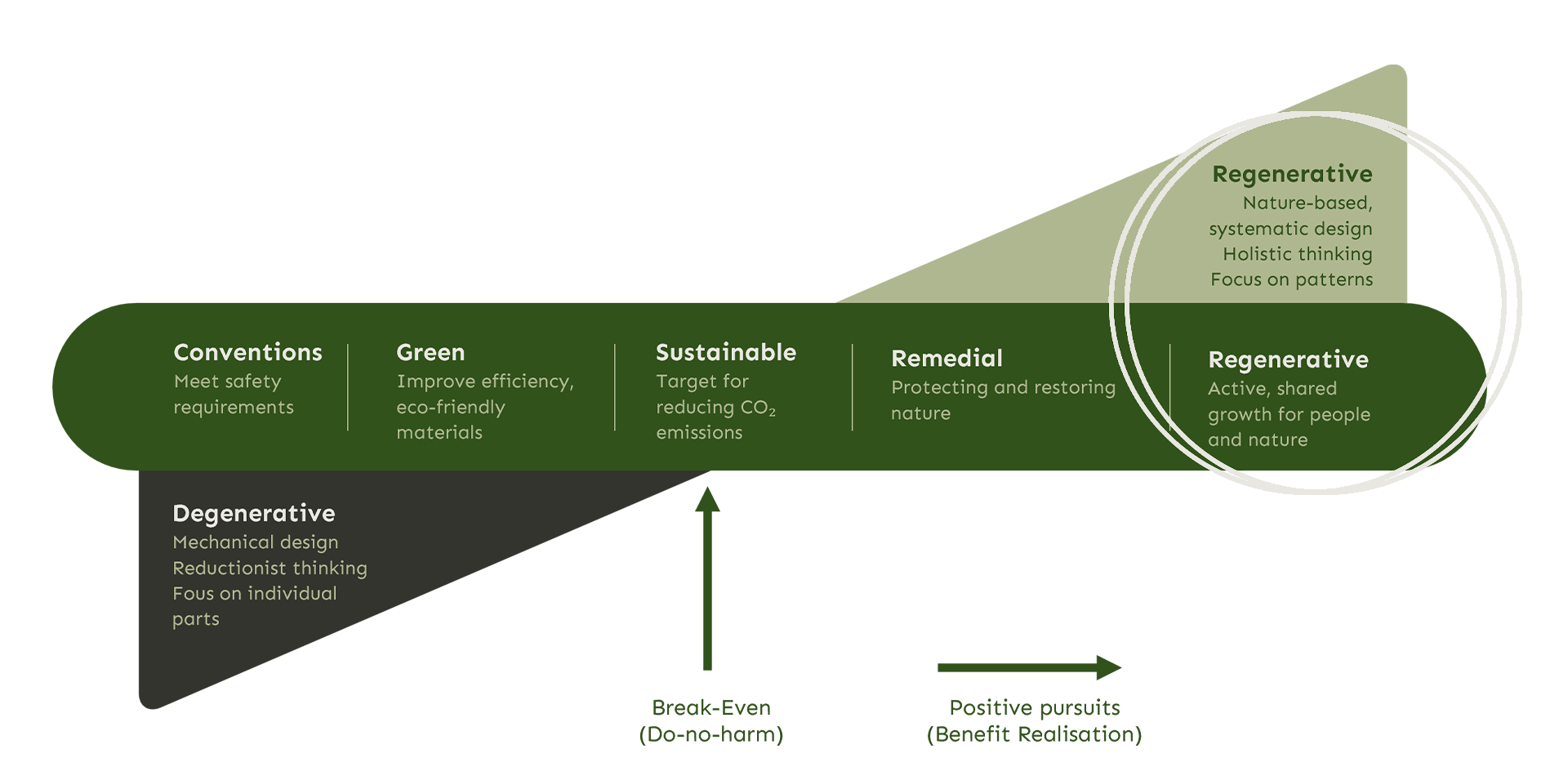
The regenerative approach is based on systems thinking and holistic design, where resource consumption, nature, social conditions and human wellbeing are understood as mutually dependent factors.
In Positive Pursuits, we work deliberately to create solutions that go beyond the balance point and contribute to restoration and long-term value. The aim is to develop coherent solutions that reduce resource consumption while strengthening human qualities.
In this way, Positive Pursuits are not an addition to the process, but an integrated part of how we understand and develop construction in practice.
A paradigm for regenerative practice
At Søren Jensen, we have developed a paradigm for regenerative construction, providing a shared framework for working with planetary and human health in practice.
The paradigm consists of 12 categories that together describe a movement from avoiding harm to actively contributing in a positive way. In each category, we distinguish between break-even, where construction is in balance, and Positive Pursuits, where solutions create restoration, quality and lasting value. This clarifies both the minimum required and where the real ambitions begin.
The paradigm functions both as a direction and as a working tool. It helps us see connections, make choices and lift projects beyond minimum solutions.
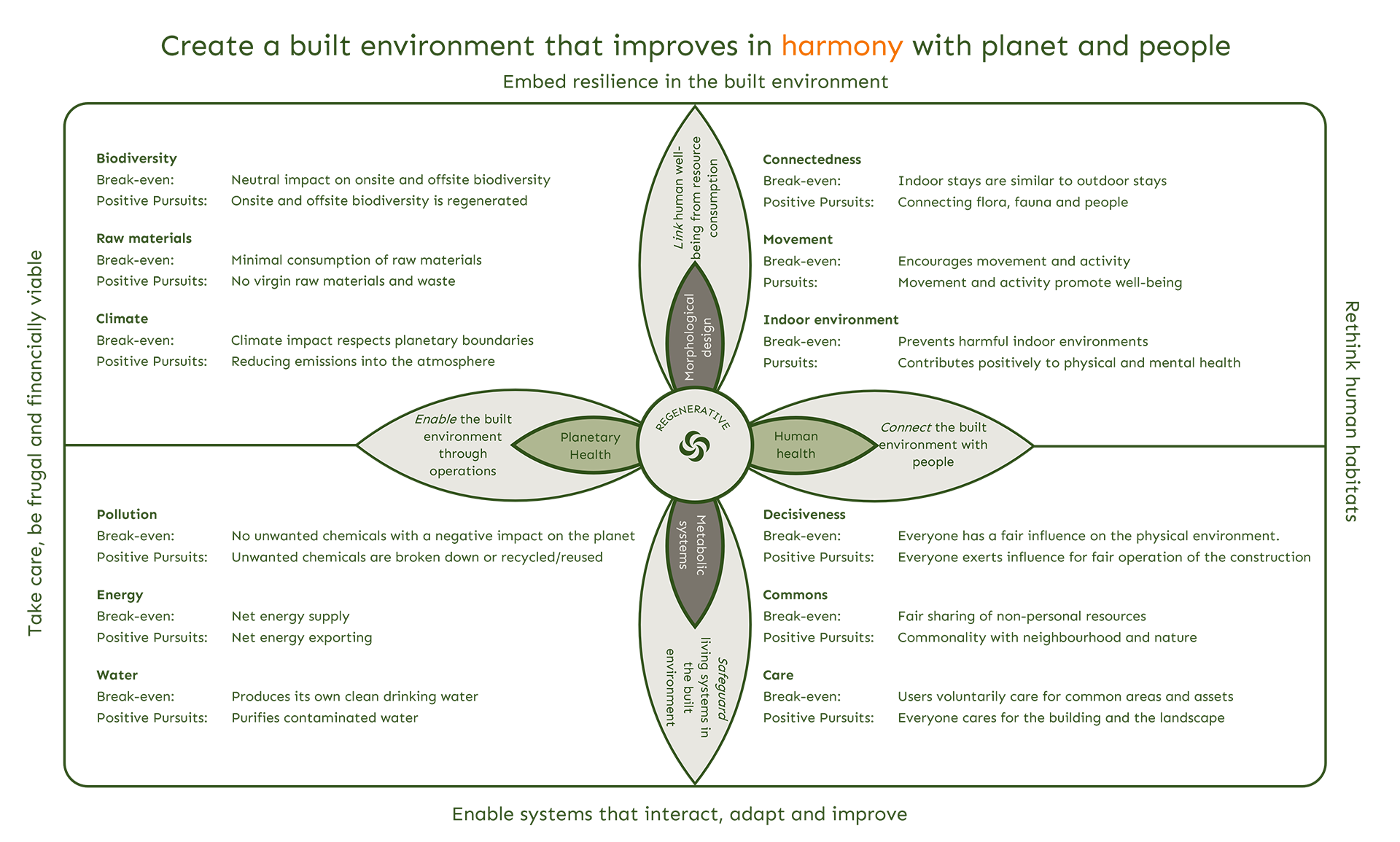
For each category in the paradigm, we work with a clear distinction between break-even, where construction is in balance and does not place further burdens on people or nature, and Positive Pursuits, where solutions contribute to restoration, quality and long-term value.
The paradigm has evolved through concrete projects, professional immersion and collaboration with external partners. In 2025, we took the next step by refining and reorganising the categories to create clearer connections between them.
This has sharpened our understanding of how planetary and human health are inextricably connected, and how construction can be restrained in its resource consumption while remaining rich in human qualities.
For us, the paradigm is not a final answer, but a shared language for raising the ambitions of what construction can and should contribute.
The work with regenerative construction does not stop here. We continue to invest in people and regenerative solutions, while also working purposefully to bridge research and construction practice. We hope you will join us on the journey.
Want to know more?

|
Hanne Tine Ring Hansen |
|
Chief Regenerative Buildings Officer |
|
+45 4194 9426 |

|
Theis Pedersen |
|
Project & Development Director |
|
+45 4194 9402 |

|
Kristian Flyvholm |
|
Chief Sales & Concept Officer |
|
+45 4194 9444 |